The Alexandrian Eclipse
Edited by Ken Emilio
The Battle for Biblical Interpretation.
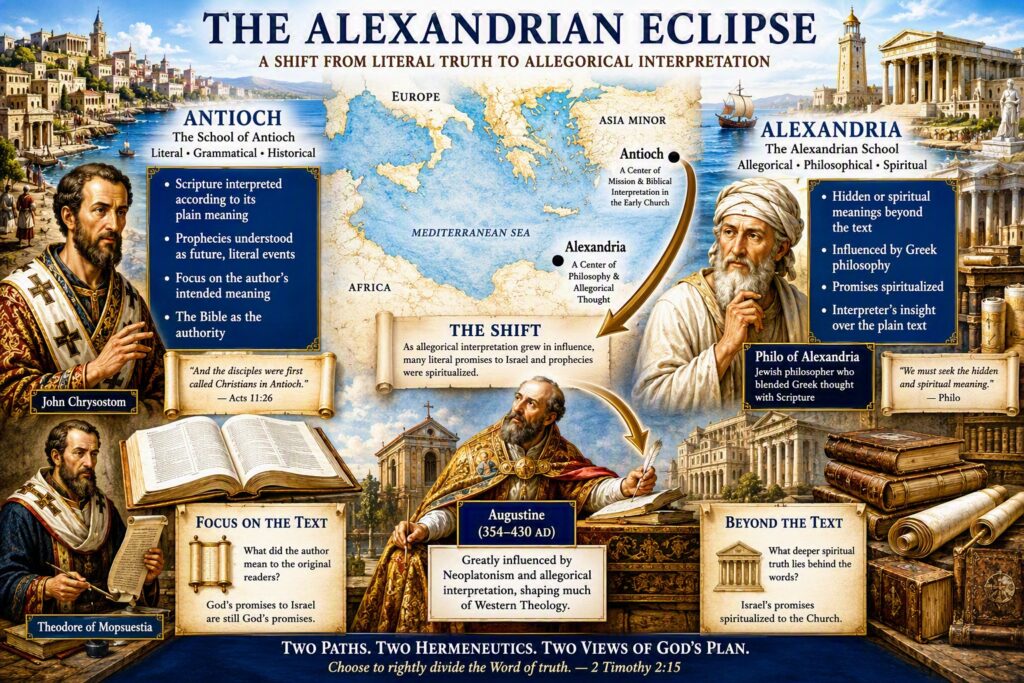
One of the most significant debates in church history concerns how Christians should interpret the Bible. Dr. Andy Woods, in his teaching The Alexandrian Eclipse, argues that the early church prior to 200 AD largely followed a literal, grammatical-historical method of interpretation centered in Antioch yet this approach was gradually eclipsed by the allegorical method associated with Alexandria, Egypt. Culminating with Augustine’s adoption of the Allegorical Method in his De Doctrina Christiana, first written in 396-397 AD. According to Woods, this shift profoundly affected Christian theology, prophecy, ecclesiology, and the church’s understanding of Israel. ¹
The School of Antioch
Antioch occupies a special place in Christian history. It was the city from which Paul launched missionary journeys and where believers were first called Christians (Acts 11:26). Woods notes that Antioch became a center of biblical interpretation that emphasized understanding Scripture according to its ordinary grammatical and historical meaning.²
The Antiochene approach recognized figures of speech, symbols, and types when the text indicated them. However, it sought first to discover the author’s intended meaning rather than hidden spiritual meanings. This method was especially important in the interpretation of Bible prophecy, where promises made to Israel and predictions concerning God’s future kingdom were understood as real future events.³
The Allegorical / Alexandria Method
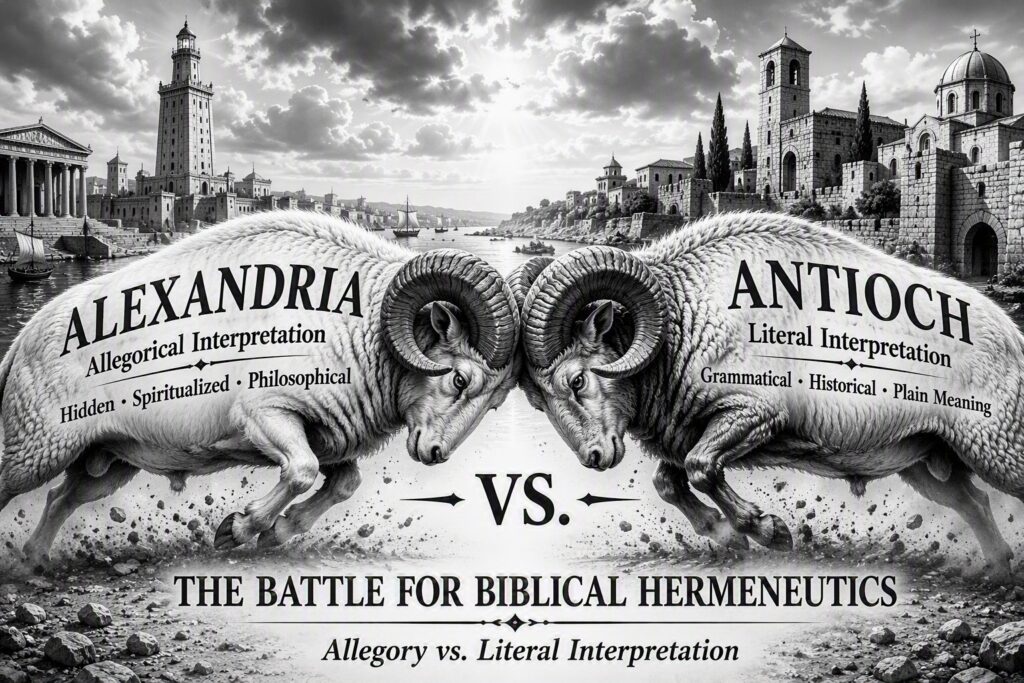
While Antioch emphasized literal interpretation, Alexandria became known for its allegorical approach. Influenced by Greek philosophical thought. Alexandrian interpreters often sought deeper spiritual meanings beneath the surface of the biblical text. Rather than focusing on what a passage plainly said, they searched for symbolic or more “important meanings” that they believed conveyed a higher spiritual truth.⁴
Example: In an Alexandrian allegorical interpretation of Luke 10:30-37, the wounded man represents humanity, the Good Samaritan represents Christ, and the inn represents the church that cares for believers. (Augustine, Questions on the Gospels 2.1)
Example: In an Antiochian literal Interpretation of Luke 10:30-37, the wounded man and the Good Samaritan were real. The plain text teaches that people should show compassion and mercy to those in need, regardless of social or ethnic differences.
Unfortunately, the Allegorical method gained increasing influence through prominent theologians and eventually shaped much of Christian theology right up to this day. As allegorical interpretation spread, many Old Testament prophecies and covenant promises were spiritualized and reinvented in ways that differed from their original Biblical context. ⁵
The Dangers of Allegorization
Woods highlights several concerns regarding the allegorical method.
First, the biblical text itself may cease to be the primary authority because the interpreter is looking beyond the text for hidden meanings. Second, authority can shift from Scripture to the interpreter who claims to discover these deeper meanings. Third, there is often no objective standard by which such interpretations can be tested. Finally, there is little restraint on the imagination of the interpreter, resulting in numerous competing interpretations of the same passage.⁶
For these reasons, advocates of the Antiochene method maintain that the safest approach is to interpret Scripture according to its normal grammatical and historical meaning unless the context clearly indicates symbolism.
Allegorization and the Rise of Replacement Theology
Allegorical interpretation played its role in the development of replacement theology, sometimes called supersessionism. Supersessionism teaches that the New Covenant in Christ fulfills and replaces the Old Covenant, making the Church the primary people of God. Old Testament promises to Israel were increasingly interpreted allegorically, many theologians concluded that the Church had permanently replaced Israel in God’s program.
Allegorical interpretation weakened the Church’s understanding of God’s continuing covenant commitments to the nation of Israel. When Israel’s future role in God’s plan was denied or minimized, anti-Jewish attitudes found easier acceptance. By contrast, the Antiochene literal method maintained that God’s covenant promises to Abraham, Isaac, Jacob, and their descendants would ultimately be fulfilled as Scripture foretold.
Why This Matters Today
The struggle between Alexandria and Antioch is more than a historical curiosity. It remains relevant and crucial because every Christian must decide how Scripture should be interpreted. If the Bible can mean whatever hidden symbolism an interpreter discovers, then doctrine becomes subjective and uncertain. However, if Scripture is interpreted according to its normal grammatical and historical sense, believers possess an objective standard by which teachings can be evaluated.
Woods argues that the Protestant Reformers recovered many essential biblical truths, such as justification by faith alone, they did this by returning to a more literal approach to Scripture. Yet he also contends that the Reformation did not consistently apply that interpretive method to all areas of the Bible, particularly prophecy. ⁷
Conclusion
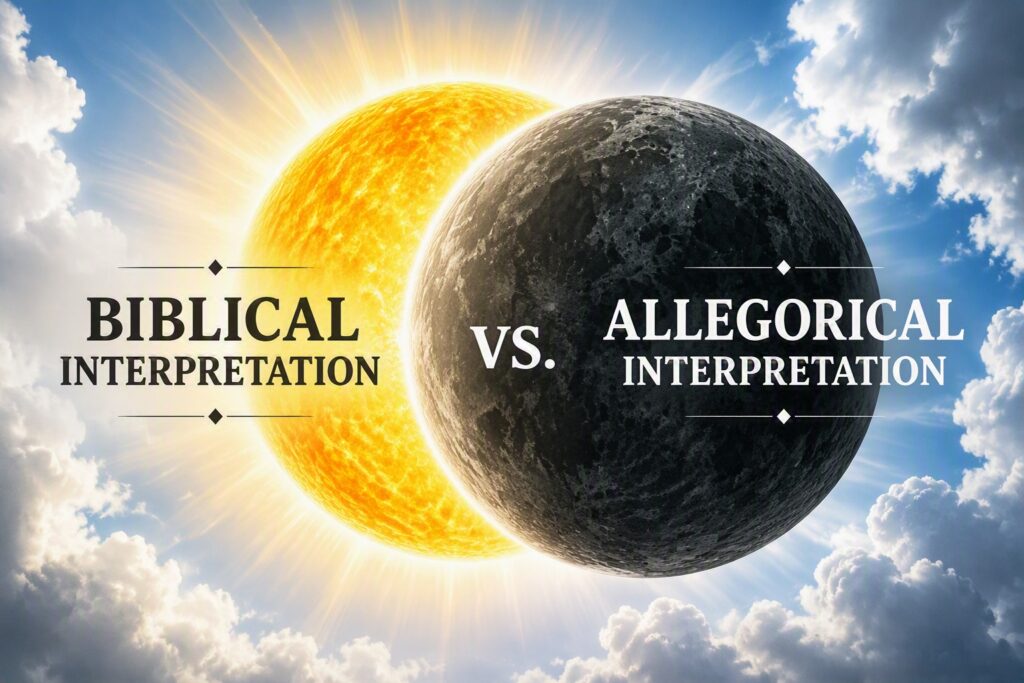
The story of the Alexandrian Eclipse is ultimately a story about biblical authority. According to Dr. Woods, the triumph of allegorical interpretation negatively altered the church’s understanding of prophecy, Israel, and God’s kingdom program.⁸
For Christians today, the lesson is clear: God’s Word should be understood according to the meaning He communicated through the biblical authors.
Israel is back in the Land and war has been declared!
Jeremiah 31:35-36 reads:
“Thus saith the LORD, which giveth the sun for a light by day, and the ordinances of the moon and of the stars for a light by night, which divideth the sea when the waves thereof roar; The LORD of hosts is his name: If those ordinances depart from before me, saith the LORD, then the seed of Israel also shall cease from being a nation before me for ever.”
Footnotes

- Andy Woods, The Alexandrian Eclipse, discussing the contrast between the literal Antiochene tradition and the allegorical Alexandrian tradition. [spiritandtruth.org], [spiritandtruth.org]
- Woods identifies Antioch as a center of early Christian growth and literal biblical interpretation. [spiritandtruth.org], [youtube.com]
- Woods argues that the early church and the Antiochene school generally interpreted biblical prophecy according to its normal grammatical and historical meaning. [spiritandtruth.org], [youtube.com]
- Woods contrasts Alexandria’s allegorical method with Antioch’s literal hermeneutic and notes philosophical influences behind the Alexandrian approach. [youtube.com]
- Woods presents the Alexandrian school as a major influence in the shift toward allegorical interpretation within church history. [spiritandtruth.org], [spiritandtruth.org]
- Woods cites classic dispensational critiques of allegorization, including the concerns that authority moves from the biblical text to the interpreter and that interpretation becomes subjective. [slbc-wordp…zonaws.com], [youtube.com]
- Woods argues that the Protestant Reformers recovered the grammatical-historical method in many doctrinal areas but did not always apply it consistently to prophecy. [slbc-wordp…zonaws.com], [spiritandtruth.org]
- Woods presents the Alexandrian-Antiochene conflict as a pivotal development affecting later Christian doctrine and prophetic interpretation. [spiritandtruth.org], [youtube.com]
Sources
- Andy Woods, Protestant Reformation 2: The Alexandrian Eclipse (Transcript), SpiritAndTruth.org. [spiritandtruth.org]
- Andy Woods, The Alexandrian Eclipse, SpiritAndTruth.org Resource Page. [spiritandtruth.org]
- Andy Woods, Ever Reforming 02: The Alexandrian Eclipse (Video Presentation). [youtube.com]
- Protestant Reformation Session 2 Slides: The Alexandrian Eclipse. [slbc-wordp…zonaws.com]