

Pastor Brian Johnson

Q.We’ve had a number of questions about Christians standing up for their rights. We’ve tried to suggest “turning the other cheek” or “bless your enemies.” But, some feel their anger is justified and Biblical. So they believe they should express “righteous indignation” as Jesus did when He overturned the tables in the Temple. What would you tell them about expressing appropriate or inappropriate anger?
(K & V)
Answer:
Zeal for His Father’s House
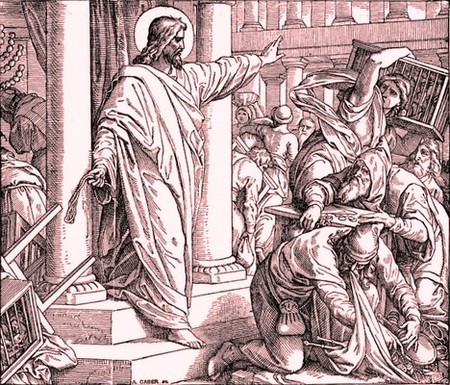
It makes me angry. . . I mean it “bothers” me when people “bristle” at the clear teachings of Scripture (“turn the other cheek;” “bless your enemies”).1 Rarely do we as fallen sinners (1 Tim 1.15) express “righteous indignation.”
Christ was angry because zeal for His Father’s house consumed Him (John 2.17). He was overwhelmed with a passion to see God glorified, so He was rightly indignant when the place that was to be set apart for God’s name was desecrated.
Our “Rights” Violated
We, on the other hand, typically get angry because our so-called rights have been violated or our character has been attacked. Ask the people who get “righteously indignant” in such a situation how often they are equally angered when someone defames the name of God . . . or how about when they themselves defame God’s name by their own sin.
If personal attacks were grounds for anger and retaliation, then Jesus could have never put down His whip. He was always being castigated or besmirched in one way or another, but “while being reviled, He did not revile in return; while suffering, He uttered no threats, but kept entrusting Himself to Him who judges righteously” (1 Pet 2.23).
Romans 12:17 – 21 Never pay back evil for evil to anyone. Respect what is right in the sight of all men. 18 If possible, so far as it depends on you, be at peace with all men. 19 Never take your own revenge, beloved, but leave room for the wrath of God, for it is written, “VENGEANCE IS MINE, I WILL REPAY,” says the Lord. 20 “BUT IF YOUR ENEMY IS HUNGRY, FEED HIM, AND IF HE IS THIRSTY, GIVE HIM A DRINK; FOR IN SO DOING YOU WILL HEAP BURNING COALS ON HIS HEAD.” 21 Do not be overcome by evil, but overcome evil with good.
1 Thessalonians 5:15 See that no one repays another with evil for evil, but always seek after that which is good for one another and for all people.
1 Peter 3:8-9 To sum up, all of you be harmonious, sympathetic, brotherly, kindhearted, and humble in spirit; 9 not returning evil for evil or insult for insult, but giving a blessing instead; for you were called for the very purpose that you might inherit a blessing.

Christian Rights
The above verses may be hard to practice, but they are not hard to understand. We naturally tend to defend our “rights” because we typically think more highly of ourselves than we ought to think (Rom 12.3; Prov 26.12) and because we naturally look out for our own personal interests, and not for the interests of others (Phil 2.4).
“Giving a blessing” instead of “returning evil for evil or insult for insult” is opposed to our nature and it is opposed to the prevailing “wisdom” of our culture, but it is biblical. It is what makes love Christian love.
Sons of Your Father
Anyone can love the people who love them (Matt 5.46-47), but the command of Christ was, “Love your enemies and pray for those who persecute you” (5.44). Our first response to that statement might be, “Why?” Verse 45 answers, “So that you may be sons of your Father who is in heaven.”
The point is that we as believers represent our Heavenly Father and are therefore to reflect His character to a watching world. And He tangibly demonstrates His love even to those who curse Him: “For He causes His sun to rise on the evil and the good, and sends rain on the righteous and the unrighteous.”
True Strength
Of course, our world believes that praying for those who persecute you and refraining from retaliation is equivalent to being a “doormat.” Paul, on the other hand, said, “I am well content with weaknesses, with insults, with distresses, with persecutions, with difficulties, for Christ’s sake; for when I am weak, then I am strong” (2 Cor 12.10).
The irony is that the person who can sustain “insults” and “persecutions” without retaliating or lashing out in anger for the sake of his rights is truly strong. He is the man with the spine of steel, for in his weakness he is made truly strong by the all-sufficient grace of Christ. The fruit of the Spirit has prevailed in his life so that peace, patience, kindness, gentleness and self-control (Gal 5.22-23) triumph over the juvenile and almost invariably self-centered response of retaliation.
Anger Controls the Weak
In truth, it is the fool and the weak man who rises instantly to his own defense (Prov. 20.3; 29.11, 20). And he shows himself to be the slave of the one who incites him, for “he who angers you controls you” (who’s the doormat now?).
The man of godly virtue and wisdom can be walked upon all day long, for he knows that such was the lot of his Lord (“If they persecuted Me, they will also persecute you”Jn 15.20). But throughout the day he is continually renewed by the gentle words of his Savior who whispers in his ear,
“My grace is sufficient for you, for power is perfected in weakness” (2 Cor 12.9);
“Blessed are you when people insult you and persecute you, and falsely say all kinds of evil against you because of Me. Rejoice and be glad, for your reward in heaven is great” (Matt 5.11-12).
The Strong Doormat

In short, the one who by our world is called a “doormat” on account of his identification with Christ is the one who is truly strong, truly blessed, and who awaits an incomparable heavenly reward.
He shows himself to be triumphant over the one who would incite him to anger and enslave him to the bondage of bitterness. His enemy, while reviling him, says, “Revile in return so that I might mock you and your God.” But Peter writes, “Keep a good conscience so that in the thing in which you are slandered, those who revile your good behavior in Christ will be put to shame” (who’s the doormat now?1 Pet 3.16).
Counter Attack
On the other hand, there is a time in which it is appropriate to stand up and mount a counter offensive. In Scripture, this seems to be directly connected to the preservation of precious truth.
Study the apostle Paul’s responses to all the slander and defamation of his character coming from the contentious element in the Corinthian assembly, and you will find that he was not merely defending his own rights or retaliating because he felt he had been “wronged.” What was at stake was the gospel itself.
If his enemies could succeed in defaming his character, then they could potentially discredit the very message he preached. So he was forced to respond only by virtue of the fact that God’s truth was at stake. The spiritual condition of the Corinthians was in danger.
Contending Earnestly for the Faith
– So he could also speak harshly against the Galatians, (“You foolish Galatians, who has bewitched you?”3.1) for their tendency to embrace “a different gospel” (1.6).
– And he could speak of opposing Peter “to his face” (Gal 2.11) for compromising the true gospel.
– And he could tell Titus that an elder needed to be able to “exhort in sound doctrine and to refute those who contradict” (1.9).
– And he could speak of handing Hymenaeus and Alexander “over to Satan” (1 Tim 1.20) and of rebuking a recalcitrant elder in the presence of all (5.20).
– And Jude could exhort, “Contend earnestly for the faith which was once for all handed down to the saints” (1.3).
Legitimate Righteous Indignation
In such cases as the above, the display of righteous indignation is legitimate because something higher than self has been violated. The nature and character of God and the truth that is His are at stake, so confrontation is justified, but again, never for selfish reasons,
“Zeal for Your house will consume me” (Jn 2.17; cf. Num 25.11“jealous with My jealousy”).
Did God Really Say…?

Much more could be said (e.g. David’s example in 2 Sam 16.5-12), and “yah buts” will no doubt be multiplied. For those who “bristle” at the word of God, the issue is one of authority. Has God spoken or has He not?
All too often, experienced based theology or secular “wisdom” is made to trump the clear words of holy writ. Sadly, the one who denies the word of God is always the loser. Joy belongs to those who regard the word of the LORD as precious (Psa 19.8, 10-11).
______________________________________________
End Notes
1Though I acknowledge that some, because of dispensational distinctions, argue that the Sermon on the Mount does not apply to church age believers. However, the clear admonitions of Rom 12.17-21, 1 Thess 5.15 and 1Pet 3.8-9 make it obvious that the command to love our enemies applies to the church.
Editor’s Note: Pastor Brian Johnson is the senior pastor at Applegate Community Church in Southern Oregon. He is a gifted minister who holds a Master of Divinity from the Master’s Seminary in Sun Valley, CA. He received his B.A in Bible-Theology from Moody Bible Institute with an emphasis in Biblical Languages. His wife, Kelly, is also accomplished and received her Bachelor of Science degree from Moody Bible Institute. Pastor Brian notes, “I am committed to expository preaching because I am convinced that God chooses to work by His Spirit through His word…divine authority and power for change comes from the Bible and not from the preacher.”