

Synthesis of a Heiser/Van Dorn World view to develop a reactivation of Israels role as the army of God.

1948 became the historical ignition point: the moment when Israel’s national existence reappears visibly on the stage of history, triggering spiritual, ideological, diplomatic, and eventually military resistance.
Here is a tightened expanded version:
Under a Heiser and Van Dorn inspired Divine Council hypothesis, the establishment of the State of Israel in 1948 marks the modern reactivation of biblical Israel’s ancient role as Yahweh’s earthly spearhead, covenant witness, and military sign against the rebel elohim who rule the disinherited nations. Just as the demons feared Jesus because His arrival signaled the nearness of their appointed judgment, the rebel powers would perceive national Israel’s restoration as an eschatological alarm: a visible sign that Yahweh’s campaign to reclaim the nations has entered a decisive phase.
In this reading, the creation of the State of Israel on May 14, 1948, is not merely a political event but a prophetic and cosmic signal. Israel’s Declaration of Independence explicitly grounded the new state in the Jewish people’s ancient connection to the land, exile, return, national rebirth, and survival after the Holocaust. The State of Israel was later admitted to the United Nations on May 11, 1949, confirming its place among the nations even as conflict over its legitimacy persisted. [gov.il], [digitallib…ary.un.org]
Using Michael Heiser’s Divine Council framework, the nations were allotted to lesser elohim after Babel, while Israel became Yahweh’s own inheritance. That means Israel’s national existence is not incidental. It represents Yahweh’s territorial and covenantal claim within history. If the rebel elohim understand Psalm 82 as their coming death sentence, then the restoration of Israel would be perceived as a direct threat to their dominion over the nations.
Adding Douglas Van Dorn’s emphasis on holy war, sacred geography, giants, territorial spirits, and the military dimension of Yahweh’s conflict with rebellious powers, Israel’s return to the land becomes more than restoration. It becomes a strategic reoccupation of contested sacred space. In that sense, modern Israel functions as a renewed sign of Yahweh’s army, not necessarily in a simplistic ethnic or political sense, but as the visible historical marker that the divine war for the nations is still unfolding.
From this perspective, the post-1948 revival of antisemitism, Jew hatred, international hostility, isolation, and the eschewing of national Israel would be interpreted as expected spiritual resistance. If Israel’s restoration signals the collapse of the rebel elohim’s authority, then opposition to Israel is not merely ideological or geopolitical. It is the earthly symptom of a deeper supernatural panic. Modern data also shows that antisemitic incidents have risen sharply in recent years, with the ADL reporting 9,354 antisemitic incidents in the United States in 2024, the highest total in its tracking history, and noting that for the first time a majority of incidents involved Israel or Zionism-related elements. [adl.org], [adl.org]
The analogy to the demons in the Gospels is central:
“Have you come here to torment us before the appointed time?”
The demons recognized Jesus’ authority and feared that His presence meant judgment had arrived ahead of schedule. In the same way, within this hypothesis, the rebel elohim and their earthly systems recognize the restoration of Israel as a prophetic countdown marker. Their rage would grow because Israel’s existence testifies that Yahweh has not abandoned His covenant, His land, His people, or His intention to reclaim the nations.
Thus the expected sequence would be:
- 1948: National Israel is restored Israel reappears as a sovereign nation, signaling the reentry of biblical Israel into world history.
- The rebel powers perceive a threat If the nations remain under corrupt spiritual administration, Israel’s restoration threatens that order.
- Antisemitism intensifies Jew hatred becomes the spiritual reflex of powers that fear Yahweh’s covenantal purposes.
- National Israel is isolated Diplomatic pressure, moral inversion, delegitimization, and international accusation become instruments of containment.
- The nations gather against Israel The prophetic pattern anticipates a final convergence of hostile nations against Jerusalem and Israel.
- Kinetic war follows The prophets portray the conflict as ultimately moving beyond rhetoric, diplomacy, and ideological hostility into actual military confrontation.
The expanded thesis could therefore read:
If the Divine Council worldview is correct, then the 1948 establishment of Israel represents the modern reappearance of Yahweh’s covenant nation as His historical spearhead and visible army-sign against the rebel elohim. The resulting explosion of antisemitism, Jew hatred, delegitimization, and international isolation is not accidental but the predictable reaction of spiritual rulers who know their dominion is threatened. Just as demons trembled before Christ because He signaled their appointed judgment, the rebel elohim and the nations under their influence would fear Israel’s restoration because it announces the approaching collapse of their rule. The prophetic expectation is therefore that this hostility will culminate in kinetic war, as the nations gather against Israel and Yahweh decisively vindicates His name, His covenant, His people, and His claim over all the earth.
A shorter version:
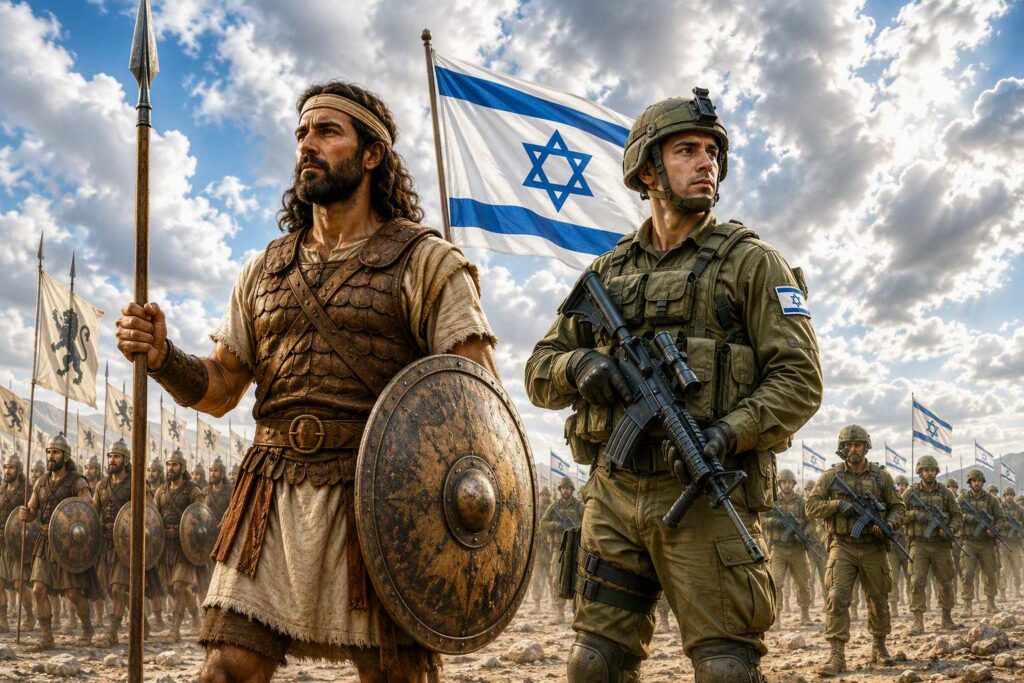
Modern Israel’s establishment in 1948, under a Heiser-Van Dorn Divine Council hypothesis, is the visible reactivation of biblical Israel’s role as Yahweh’s covenant army-sign in the war to reclaim the nations. The revival of antisemitism and the isolation of Israel are understood as the panic response of rebel elohim and their earthly order, who recognize that Israel’s restoration signals their coming judgment and the eventual prophetic war in which Yahweh will overthrow the powers and reclaim the earth
Under a Divine Council framework, the establishment of the State of Israel in 1948 may be viewed as the modern reemergence of biblical Israel as Yahweh’s covenant nation and earthly instrument in the reclamation of the nations.^1 Following the Babel event, the nations were allotted to subordinate spiritual beings who later became corrupt and ruled in defiance of Yahweh’s authority.^2 Israel was chosen as Yahweh’s inheritance and served as the primary vehicle through which He would challenge the dominion of these rebellious powers.^3 In this model, the restoration of national Israel signals a renewed stage in the cosmic conflict between Yahweh and the rebel elohim. Consequently, rising hostility toward Israel, including antisemitism, political isolation, and international opposition, may be interpreted as manifestations of resistance to Yahweh’s reclamation project.^4 As the Kingdom of God advances through both Israel and the worldwide people of God, the authority of the rebel powers progressively deteriorates, ultimately culminating in the eschatological confrontation anticipated by the biblical prophets.^5
Footnotes
- Michael S. Heiser, The Unseen Realm: Recovering the Supernatural Worldview of the Bible (Bellingham, WA: Lexham Press, 2015), 113-132, 285-302.
- Heiser, The Unseen Realm, 113-126; Michael S. Heiser, “Deuteronomy 32:8 and the Sons of God,” Bibliotheca Sacra 158, no. 629 (2001): 52-74.
- Heiser, The Unseen Realm, 121-132, 193-213.
- Douglas Van Dorn, Giants: Sons of the Gods (Enumclaw, WA: Waters of Creation Publishing, 2013), 39-72; Douglas Van Dorn, Brian Godawa, and Judd Burton, The Angel of the Lord: A Biblical, Historical, and Theological Study (Lexington, KY: FBP, 2019), 221-248.
- Heiser, The Unseen Realm, 363-386; Douglas Van Dorn, Giants: Sons of the Gods, 145-178.
Bibliography
Heiser, Michael S. The Unseen Realm: Recovering the Supernatural Worldview of the Bible. Bellingham, WA: Lexham Press, 2015.
Heiser, Michael S. “Deuteronomy 32:8 and the Sons of God.” Bibliotheca Sacra 158, no. 629 (2001): 52-74.
Van Dorn, Douglas. Giants: Sons of the Gods. Enumclaw, WA: Waters of Creation Publishing, 2013.
Van Dorn, Douglas, Brian Godawa, and Judd Burton. The Angel of the Lord: A Biblical, Historical, and Theological Study. Lexington, KY: FBP, 2019.
Additional Sources Often Used Alongside Heiser and Van Dorn
- Gregory K. Beale, A New Testament Biblical Theology (2011).
- G. K. Beale and Benjamin L. Gladd, The Story Retold (2020).
- Richard E. Averbeck, “The Message of the Divine Council in the Hebrew Bible.”
- John H. Walton, The Lost World of Scripture and related Ancient Near Eastern studies.
- Patrick D. Miller, The Divine Warrior in Early Israel (1973), particularly for the “Army of Yahweh” and holy-war motif.
These sources provide stronger academic support for the Divine Warrior/Army of God theme than Van Dorn alone and help situate the hypothesis within broader biblical theology.