

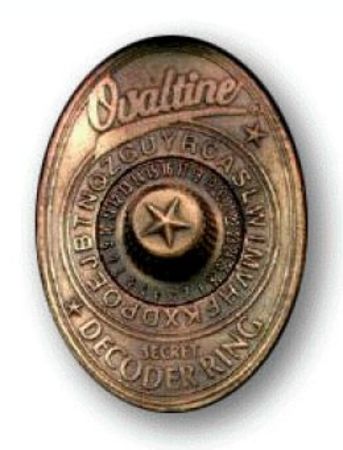
Q. Why are Christians so thick headed? Why are there factions that interpret God’s Word & then create theology platforms around interpretations? Our Creator didn’t transmit a message to us that requires a “secret decoder ring.” Christians shouldn’t be complicating his communication to us. Jesus said let your Yes be Yes and your No be No. While the Bible does contain complex integrated messages within each book those messages are not complicated to discover or understand – once you develop knowledge in a particular field such as Finance, Accounting, Engineering, Science, Physics, Humor or any other profession that God created. What is wrong with us? (T.M.)
Answer:

We Need People Like You
That’s really hilarious, T.M. I guess many theologians, pastors, Bible teachers and “churched” Christians do act as if we all need a “secret decoder ring” to understand the Bible. That’s why we all need humor just like yours to “lighten up” from time to time! Good points…we suggest you bring your message to other believers whenever you can. It will bring a needed smile on our faces.
Bunch of Snake Heads
Surprisingly, Jesus didn’t like elitist, hypocritical, judgmental and divisive people either. In fact, he repeatedly warned against the “religious right” or the “moral majority” of his day. He even called the Pharisees a “brood of vipers” whose father was the devil! Joining Him in such denunciations was John the Baptist, too. Between them they “ripped” the religious right:
“But when he saw many Pharisees and Sadducees coming to watch him baptize, he denounced them. ‘You brood of snakes!’ he exclaimed. ‘Who warned you to flee God’s coming wrath? Prove by the way you live that you have repented of your sins and turned to God” (Matthew 3:7-8, NLT).
Woes on Religious Right
Continuing on with His opinion, Jesus pronounced a series of “woes” upon those leaders. He said they were “hypocrites,” “blind guides,” whitewashed tombs” and other choice words (Matthew chapter 23).
Love the Outcasts
It is astonishing, however, that Jesus never called outcasts, prostitutes, hated tax-collectors or even ordinary criminals by those names. To those upon whom society looked down Jesus was gracious and loving.
Love the Humble
Outward piety, overtly religious elitism and other outward manifestations of a righteous life are not something God requires for his children. Instead, He seeks men who are humble and lowly – not given to bragging or an exalted sense of self-esteem. Yet, it seems like we worship at the Altar of High Self-Esteem, doesn’t it?
Assembling Togethers
While the Lord does tell us “not to forsake our own assembling together” (Heb 10:25), He doesn’t require we attend a large, institutionalized church in order to worship Him. In fact, the earliest first-century Christians met in house churches (Rom 16:5, 14-15). These gatherings varied from about 3-7 members to around 100 people in each group.
Early Church Practices
It is fascinating to study what those early believers did or did not do in church. Maybe we can take our “cue” from them.
When they met they studied the Scriptures (Old Testament), the apostles’ teachings / letters, and devoted themselves “to fellowship and to sharing in meals (including the Lord’s Supper), and to prayer”…”And all the believers met together in one place and shared everything they had”…They worshiped together at the Temple (or synagogues), met in homes for the Lord’s Supper, and shared their meals with great joy and generosity – all the while praising God and enjoying the goodwill of all the people” (Acts 2:42-48, NLT).
Biblical Church Worship
You can do almost the same, too, if you like. You might want to look for a smaller church or a big church with small groups and good home Bible study groups as well. In Acts we find a description of “good” conscientious Bible students:
“And the people of Berea were more open-minded than those in Thessalonica, and they listened eagerly to Paul’s message. They searched the Scriptures day after day to see if Paul and Silas were teaching the truth” (Acts 17:11, NLT).
Gospel Simplicity
In the case of these dedicated Bereans we suspect they were carefully studying their Old Testament to see if certain passages Paul or Silas taught really did foretell the Messiah and facts about Jesus’ identity, life and ministry. That is what the gospel message means when it says “Christ died for our sins, just as the Scriptures said. He was buried, and he was raised from the dead on the third day, just as the Scriptures said” (1 Cor 15:3-5, NLT). “Just as the Scriptures said” means that something about Jesus was prophesied in the Old Testament. The Bereans were determined to find it and prove it so.
Cultic Beliefs
But, the refining and clear understanding of doctrinal issues became necessary from the very beginning as Christianity spread to other areas in the Roman Empire and beyond. Cultic groups such as the Gnostics began to sway people from the truth in various locations throughout the area.
For example, some preached Christ had not really appeared in the “flesh.” He was just a “spirit.” Some Roman Mystery religions such as Mithraism borrowed sacraments from the church and adulterated Christian practices such as Baptism and Communion.
We find various groups and cults emerging such as the Ebionites who over emphasized the Old Testament law, the Marcionites who rejected the God of the Old Testament, and the Montanists who placed special favor upon gifts of the Spirit and continuing revelation.
Systematic Theology?
For Gentiles who had no exposure to the Bible or Jewish beliefs and practices it was necessary to start from “ground zero” to teach them the basics. This meant church leaders had to explain everything from scratch. Many of the earliest believers were slaves and commoners. Paul described them as “not many mighty, not many noble…God has chosen the foolish things of the world to confound the wise” (1 Cor 1:26-27). Many had no concept of Jewish Law or Levitical sacrificial rites.
Hierarchical Organization
The earliest churches had elders and bishops (sometimes used interchangeably). There were deacons who assisted them with various duties and tasks. But, we didn’t see elaborate, hierarchical structures until the second and third centuries.
Nevertheless Christianity emerged from Jewish roots. The earliest organization of the church was founded upon the Sanhedrin. The church depended upon the Hebrew Scriptures and the writings of the apostles. Then the writings of the Church Fathers became cherished such as the Didache, The Shepherd of Hermas, and Clement’s Letter to the Corinthians (Hannah 2004, 7).
Christology & Sacraments
The earliest believers viewed Christ as “the Lord of the entire universe” and as “our God.” In fact, in 2007 archaeologists discovered an inscription in the oldest church ever found in Israel with the words, “Christ God.” It is clear from our earliest records that believers worshiped Christ as God and celebrated Baptism and Communion when they met.
Trinitarian Issues
However, heresies and fights over the true nature of Christ’s divinity or humanity, his bodily or spiritual resurrection, his pre-existence or bodily birth and other things caused church leaders to struggle to maintain the purity of church doctrines.
Councils
It is easy to understand why it was necessary for the early and medieval church to begin to define and clarify its doctrines and the justification of its church structures and practices. For this they called meetings or “Councils” such as the Council of Nicea (325 A.D.), the Council of Constantinople (381 A.D.) and the other councils we read about in church history.
Amazing Agreement
Considering all of this it is amazing that we have such unified beliefs among Christian denominations anyway. When it comes to the essentials of the salvation message we are in absolute agreement. This is because our unification will always occur if Christian denominations use the Bible as their source document.
Global Phenomenon
As a whole the Protestant and Catholic churches believe that Jesus is Lord who died for our sins. We believe He rose from the dead. To commemorate the Lordship and Redemptive powers of Christ we all celebrate Baptism and Communion. This is the true “Catholic” Church or the entire church worldwide. (That is the original meaning of “Catholic”). We are a truly global institution whose members believe a very simple message.
Ancients Books Require Translators
If we want to learn chemistry or calculus we study with professors who are knowledgeable in that field. In the same way if we want to learn about the true meaning found in a collection of books written from antiquity then we need to study them under the tutelage of educated people versed in ancient languages, cultures and history in order to understand the Bible’s original intent.
Yes, the Bible’s content is meant for the common man and thankfully the Gospel is a simple message. But, beyond that crystal-clear gospel message we also need to accept that much of the Bible is an ancient book translated or interpreted by scholars. .
Learning from the Masters
Luckily for us the Bible itself tells us it is OK to learn from the experts. Nehemiah tells us that once the people were released from Babylonian Captivity, the Levites “read from the book, from the law of God, translating to give the sense so that they understood the reading” (Nehemiah 8:8).
Here – right inside the Bible – we are told Jewish experts helped those who had lived in captivity and who were raised in other cultures to understand the sense of what the Bible said to them.
So we can enjoy our biblical studies as we, too, learn the sense of what God’s Word tells us in our quest to learn more about it. Paul tells us,
“Be diligent to present yourself approved to God as a workman who does not need to be ashamed, accurately handling the word of truth” (2 Timothy 2:15, NASB).
_________________________________
Works Cited:
Hannah, John D. 2004. The Kregel Pictorial Guide to Church History, Volume 2 – The Early Church A.D. 33-500. Grand Rapids, MI: Kregel.
Viola, Frank and Barna, George. 2002. Pagan Christianity? Exploring the Roots of Our Church Practices. Carol Stream, ILL: Tyndale.
Authors Valorie Emilio holds an M.A. in History from UCLA focusing upon early church history. Ken received the M.A. in Biblical Studies from Louisiana Baptist University and a V.O.M. Certificate in Persecuted Church Ministries from Oklahoma Wesleyan University.